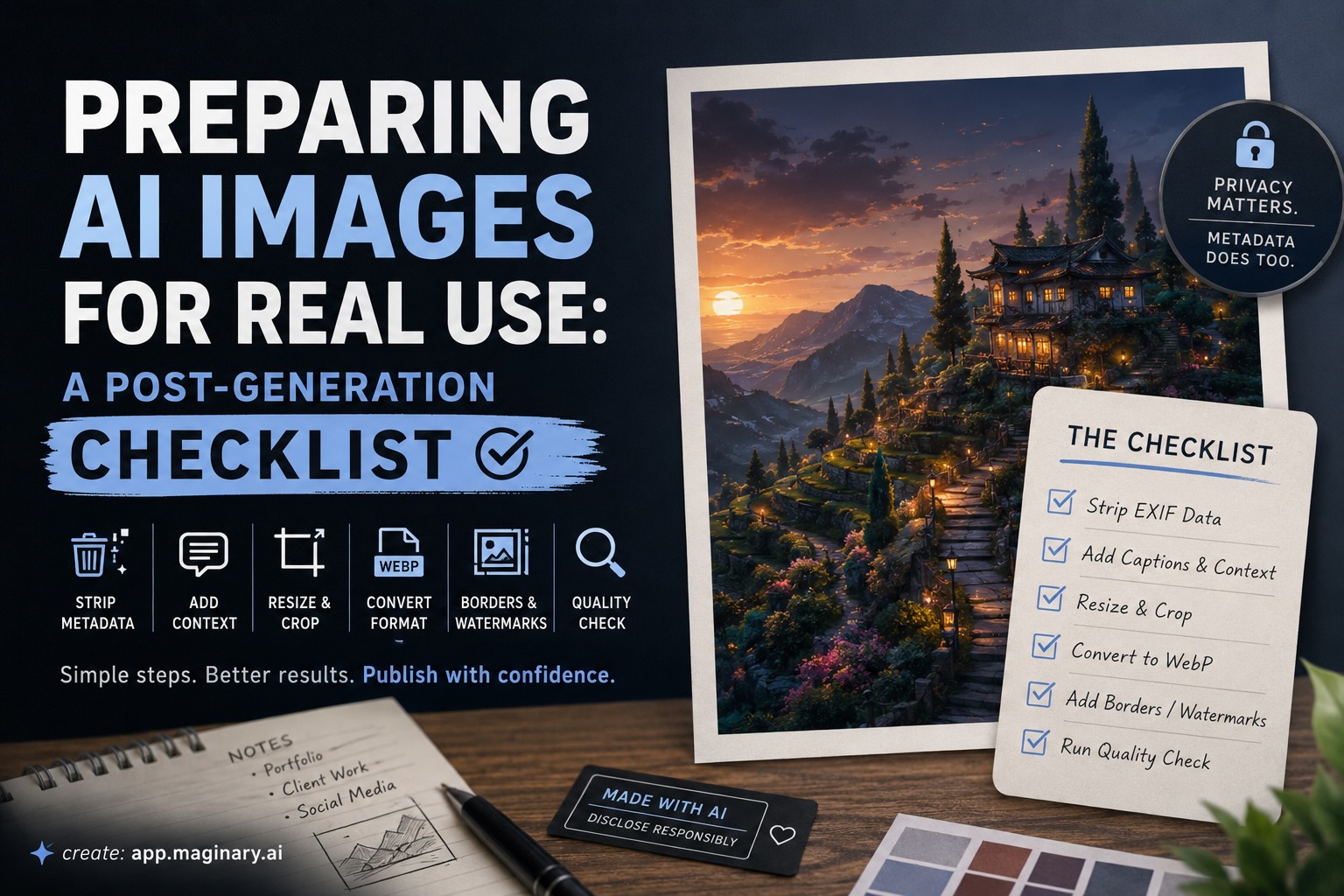
preparing ai images for real use: a post-generation checklist
a practical checklist for preparing ai-generated images for portfolios, client work, and social media, covering metadata, captions, borders, and format conversion.
insights, tutorials, and updates on ai-powered image and video generation

a practical checklist for preparing ai-generated images for portfolios, client work, and social media, covering metadata, captions, borders, and format conversion.

Two of the most-talked-about new AIs — ByteDance's Seedance 2.0 and OpenAI's GPT-image-2 (the model behind "ChatGPT Images 2.0") — are live in maginary. One prompt bar, zero app-switching: add --flagship to put them in play, or name either one directly.
Plain prompts, --flagship, and exact model triggers — the three lanes of Maginary's model selection, and how to get the right model without memorizing a menu.
From "I have an API key" to "I'm rendering the image in my app" in under ten minutes. curl + python + node examples, the full request/response shape, and how to pick between polling and webhooks.
Get a POST when your generation finishes. Payload, headers, HMAC signature verification in Python / Node / Go, retry policy, idempotency — every gotcha we've hit while shipping this in production.
-19_09_2025.png)
From text straight to mind-blowing images and videos without overthinking prompts. Any format, any language, simple UI, simple API, and no forced subscriptions.

mjapi used to be an unofficial midjourney api, but it hit a scaling ceiling early on. Now, mjapi becomes a standalone product with native models and zero Discord dependencies.

Excited to announce that the original Python source code powering mjapi.io's backend is now available! This release marks a significant pivot in our whole approach to selling access to image gen models.
Learn how to create your first AI-generated images and videos with Maginary. From YouTube thumbnails to product shots, we've got you covered.